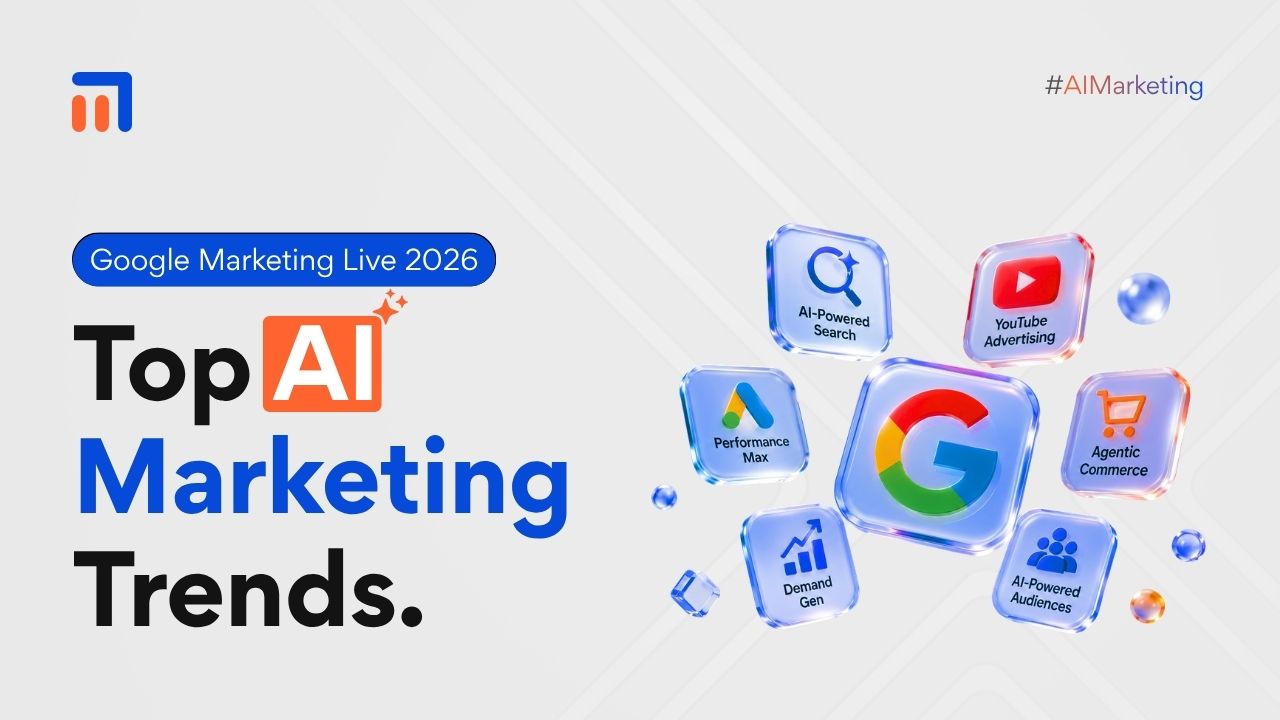
Google Marketing Live 2026 wasn’t just another product announcement event.
It marked a significant shift in how businesses will connect with customers in the coming years.
For over two decades, digital marketing has largely revolved around keywords, audience targeting, and campaign optimization. While these fundamentals still matter, Google’s latest innovations reveal a future where Artificial Intelligence plays a much bigger role in understanding user intent, creating personalized experiences, and helping businesses reach customers at the right moment.
The biggest message from Google Marketing Live 2026 was clear:
The future of advertising is not keyword-first. It’s intent-first.
Let’s explore the most important announcements and what they mean for marketers, business owners, and agencies.
Search Is Changing: From Keywords to Conversations
For years, search marketing has been built around keyword targeting.
A user searched for:
- “best CRM software”
- “digital marketing agency near me”
- “running shoes for beginners”
Advertisers targeted these keywords and competed for visibility.
Today, users are searching differently.
With Gemini-powered experiences, users are asking detailed, conversational questions such as:
- Which CRM software is best for a small business with a remote sales team?
- I need a digital marketing agency that specializes in SEO and lead generation for B2B companies.
- What are the best running shoes for flat feet under $100?
These searches contain significantly more context and intent than traditional keyword searches.
Google’s AI can now understand:
- User goals
- Context
- Preferences
- Constraints
- Previous interactions
As a result, advertisers must think beyond keyword lists and focus on providing comprehensive information about their products and services.
Why Keywords Are No Longer the Primary Signal
One of the most discussed topics during Google Marketing Live was the evolving role of keywords.
Keywords are not disappearing.
However, they are becoming just one signal among many.
Google’s AI now evaluates:
- Website content
- Creative assets
- Product information
- User intent
- Search context
- Historical performance data
This means businesses that rely solely on exact-match keywords may miss opportunities.
Instead, marketers should focus on:
- High-quality landing pages
- Comprehensive service descriptions
- Strong product feeds
- Diverse creative assets
- First-party customer data
The businesses that provide the richest information will have a competitive advantage.
AI Mode and the New Search Experience
Google introduced expanded AI-powered search experiences that deliver answers rather than simply displaying links.
Users increasingly expect:
- Direct answers
- Product recommendations
- Comparisons
- Personalized suggestions
This creates new opportunities for advertisers.
Rather than interrupting the user journey, ads are becoming integrated into the conversation.
Google emphasized that future advertising experiences will be:
- More contextual
- More helpful
- More relevant
- Better aligned with user intent
This shift will require businesses to rethink how they create content and structure their digital assets.
Performance Max and AI Max Become More Important
Google highlighted how Performance Max and AI Max campaigns will play a central role in future advertising experiences.
These campaign types allow Google’s AI to:
- Discover new audiences
- Match ads to complex search queries
- Generate relevant ad messaging
- Optimize across multiple channels
The traditional approach of manually controlling every keyword and placement is becoming less effective.
Instead, successful advertisers will:
- Feed AI better data
- Define clear business goals
- Provide strong creative assets
- Use conversion tracking effectively
The role of marketers is shifting from manual campaign management to strategic guidance and optimization.
YouTube Is Becoming a Powerful Performance Channel
Many businesses still view YouTube primarily as a branding platform.
Google’s latest announcements suggest otherwise.
Through Demand Gen campaigns and improved AI-powered targeting, YouTube is becoming a significant performance marketing channel.
Google showcased how advertisers can:
- Connect product feeds directly to ads
- Create shoppable video experiences
- Reach high-intent audiences
- Drive measurable conversions
This is particularly valuable for:
- E-commerce brands
- SaaS companies
- Service-based businesses
- Local businesses
As video consumption continues to grow, YouTube will likely become an even more critical part of the customer journey.
AI-Powered Creative Production Is Here
One of the most exciting announcements was the expansion of Asset Studio.
Google is making it easier for businesses to generate:
- Headlines
- Descriptions
- Images
- Videos
- Multiple creative variations
For smaller businesses with limited creative resources, this could be transformational.
Instead of spending weeks creating multiple ad variations, businesses can now rapidly generate, test, and optimize creative assets.
However, Google repeatedly emphasized an important point:
AI can create content, but it cannot create a unique brand identity.
Businesses still need to define:
- Their voice
- Their positioning
- Their value proposition
- Their customer experience
The brands that stand out will be the ones that combine AI efficiency with authentic messaging.
Data Has Become the Ultimate Competitive Advantage
Perhaps the most important theme throughout the event was data quality.
Google repeatedly stressed the importance of:
Proper Tagging
Businesses should ensure they have:
- Google Tag Manager configured correctly
- Enhanced conversions enabled
- Accurate conversion tracking
First-Party Data
Businesses should actively collect:
- Customer information
- CRM data
- Lead quality signals
- Offline conversion data
Data Integration
Connecting systems such as:
- CRM platforms
- Analytics platforms
- Advertising platforms
allows Google’s AI to make smarter optimization decisions.
The reality is simple:
Better data leads to better AI performance.
Merchant Center Is Becoming More Important Than Ever
For e-commerce businesses, Google introduced enhancements focused on conversational commerce.
Product feeds are no longer just inventory databases.
They are becoming rich sources of information that help AI answer customer questions.
Businesses should optimize:
- Product titles
- Descriptions
- Images
- Videos
- FAQs
- Reviews
- Product attributes
The more information provided, the more effectively Google’s AI can recommend products.
The Rise of Agentic Commerce
One of the most forward-looking topics discussed was Agentic Commerce.
In the near future, AI agents may assist users by:
- Researching products
- Comparing options
- Finding deals
- Completing purchases
To remain discoverable, businesses must ensure their product information is:
- Accurate
- Structured
- Up-to-date
- Easily accessible
Companies that prepare today will be better positioned as AI-driven shopping experiences become mainstream.
What Marketers Should Do Right Now
After reviewing all the announcements, several practical action items stand out.
1. Strengthen Your Data Infrastructure
Audit:
- Conversion tracking
- CRM integrations
- Offline conversion imports
- Google Analytics setup
2. Invest in Better Creative Assets
Create:
- Video content
- Product visuals
- Brand storytelling assets
- Multiple creative variations
3. Improve Website Content
Focus on:
- User intent
- Detailed service pages
- Helpful content
- FAQ sections
4. Optimize Merchant Center Feeds
For e-commerce businesses, this should become a top priority.
5. Embrace AI-Powered Campaign Types
Explore:
- Performance Max
- Demand Gen
- AI Max
while maintaining strong measurement and oversight.
The Biggest Takeaway from Google Marketing Live 2026
The most successful businesses in the next era of digital marketing will not be those with the biggest budgets.
They will be the businesses that:
- Understand their customers deeply
- Build strong data foundations
- Create distinctive brands
- Embrace AI strategically
- Continuously test and learn
AI is changing how advertising works.
But it is not replacing marketing fundamentals.
Understanding your audience, delivering value, and building trust remain the foundation of long-term success.
The tools are evolving rapidly.
The businesses that adapt early will have a significant competitive advantage.
The future of marketing belongs to organizations that combine human creativity with AI-powered intelligence.